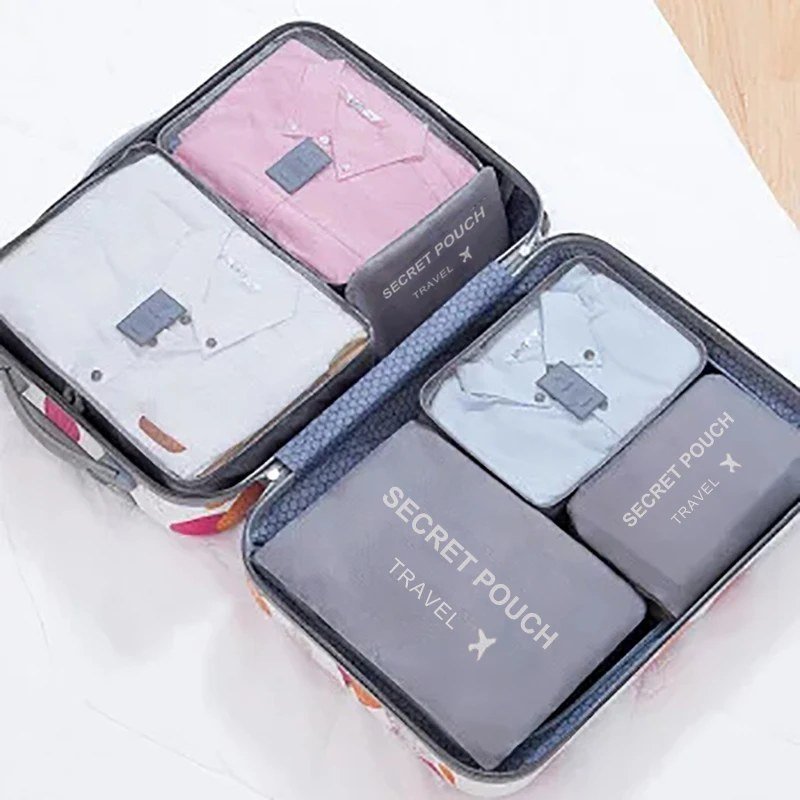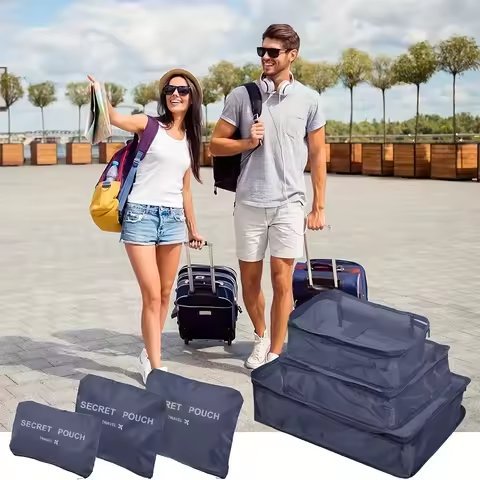
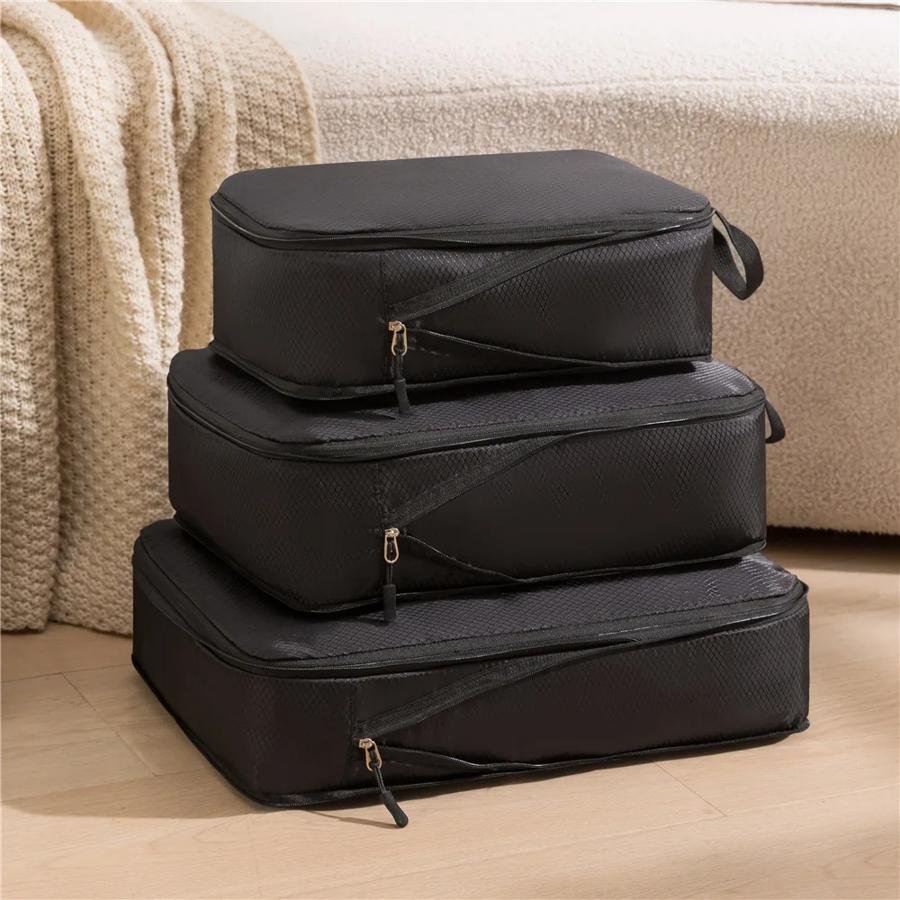
Quick answer: Most people need three or four packing cubes per person for a week away: a large for trousers and knitwear, a medium for tops, a small for underwear and socks, and a flat pouch for chargers. A carry-on weekend needs two or three. Buying more than that is usually the mistake.
What this guide covers
This is the question I get asked more than any other, and the honest answer annoys people: fewer than you think.
Almost everyone who emails us about sizing has already bought too many cubes. They own a nine-piece set, they use four of them, and the rest live in a drawer feeling like a small financial regret.
So let me give you the actual numbers, based on trips rather than on what makes a nice-looking set.
The short answer, by trip length
Here is what I would pack for one adult. Adjust for how much you sweat and how little you like doing laundry.
| Trip | Cubes | What goes where |
|---|---|---|
| Overnight / one night | 1 medium | Everything. Genuinely. |
| Weekend, 2–3 nights | 2–3 | Medium for tops, small for underwear, flat pouch for cables |
| One week | 3–4 | Large for bottoms and knits, medium for tops, small for smalls, pouch |
| Two weeks | 4–5 | As above plus a laundry or shoe bag |
| Family of four, one case | 4–6 | One cube per person, plus a shared bag for swimwear |
Notice that the numbers barely move between one week and two. That is not a mistake.
Past about seven days you are washing clothes, not carrying more of them. The cube count plateaus even as the trip gets longer, which is exactly why a packing cube set of three or four covers most of what a normal person will ever do.
Why people over-buy
Two reasons, and they are both understandable.
The first is that sets are sold by piece count. Nine pieces sounds better value than four, so nine pieces is what ends up in the basket. But a set of nine usually means three cubes and six pouches, and nobody needs six pouches.
The second is the fantasy of total order. There is a version of you who packs socks separately from underwear, separately from swimwear. That person is not real. On the night before a flight you will throw all the small things in one cube and go to bed.
Buy for the tired version of yourself. That is the one doing the packing.
The sizes that actually earn their place
If you are starting from nothing, here is the order I would buy in.
- Medium first. It is the workhorse. Tops, t-shirts, the bulk of a short trip. If you only ever own one cube, own a medium.
- Small second. Underwear, socks, swimwear, chargers. It fills the awkward gaps in a case that a large cube cannot reach.
- Large third. Trousers, jumpers, anything bulky. Skip it entirely if you only do carry-on trips, because a full large cube is often taller than a strict cabin allowance.
- Extra large last, if ever. Coats, towels, bedding. Most people never need one. See the large and extra large range if you are packing for cold weather or a family.
Exact dimensions sit on every product page, so you can measure against your case before committing. Or browse purely by size if you are topping up a system you already own.
The one-cube-one-job rule
Whatever number you land on, the system only works if each cube means one thing.
A cube for tops. A cube for bottoms. A cube for smalls. When you need a clean shirt you pull one cube, take the shirt, zip it shut. You never excavate.
The moment a cube becomes "miscellaneous", the whole thing collapses back into rummaging, and you have essentially bought expensive fabric bags. Our complete guide to using packing cubes walks through the method properly.
Families work differently
For families, stop counting by category and start counting by person.
One cube per child, in one colour per child, beats any category system I have tried. It means a seven-year-old can find their own pyjamas, and it means you can hand a cube to someone and say "this is yours" without a twenty-minute negotiation.
Four people in one large suitcase usually needs four medium cubes and one shared bag for swimwear and beach things. That is it. The family packing system guide covers the colour-coding in detail.
When more cubes genuinely help
I have spent this whole article telling you to buy fewer, so let me be fair about the exceptions.
Multi-stop trips are one. If you are moving hotels every two days and never fully unpacking, more, smaller cubes mean you open less of the bag each time.
Shared cases are another. Two adults in one suitcase need their own cubes or they will end up folding each other's clothes, which is a documented cause of arguments.
And bulky-kit trips are the third. Ski gear, winter coats, wetsuits — that is where a compression cube pays for itself, because the problem is volume rather than organisation.
What to do if you already over-bought
Do not throw the spares away. Put them to work off the plane.
Spare cubes are quietly brilliant for a hospital bag, a gym bag, the boot of the car for kids' spare clothes, or keeping cables and adaptors together in a desk drawer. One customer uses hers to organise a caravan. Another keeps a permanently packed "swimming cube" by the front door.
The fabric bag was never the problem. It was only ever the count.
The short version
- Three to four cubes per person covers a week away; two or three covers a weekend.
- The count barely changes between one week and two, because past a week you do laundry.
- Buy a medium first, a small second, and a large only if you check a bag.
- Families should count one cube per person, not one cube per category.
- Nine-piece sets are usually three cubes and six pouches – count the cubes, not the pieces.
Frequently asked questions
How many packing cubes do I need for a week?
Three to four for one person: a large for trousers and knitwear, a medium for tops, a small for underwear and socks, and a flat pouch for chargers and documents. A matched set of three or four covers this without buying pieces you will not use.
Is a 6-piece or 9-piece packing cube set better?
Count the cubes rather than the pieces. A nine-piece set is often three cubes and six pouches, which is no more useful than a six-piece set with four cubes. Look at how many zipped cubes you actually get, and in which sizes.
How many packing cubes fit in a suitcase?
A cabin case takes about three or four graded cubes; a large hold suitcase takes six to eight. The trick is packing each cube to about ninety per cent so it stays square – firm square cubes stack far better than bulging ones.
Do I need a cube for every category of clothing?
No, and trying is where most people go wrong. Give each cube one obvious job, but keep the jobs broad: tops, bottoms, smalls. Splitting socks from underwear sounds tidy and never survives contact with an actual packing night.
How many packing cubes does a family of four need?
Four to six – one cube per person in a different colour, plus one shared bag for swimwear or beach things. Colour-coding by person beats any category system, because children can find their own clothes without unpacking the case.