
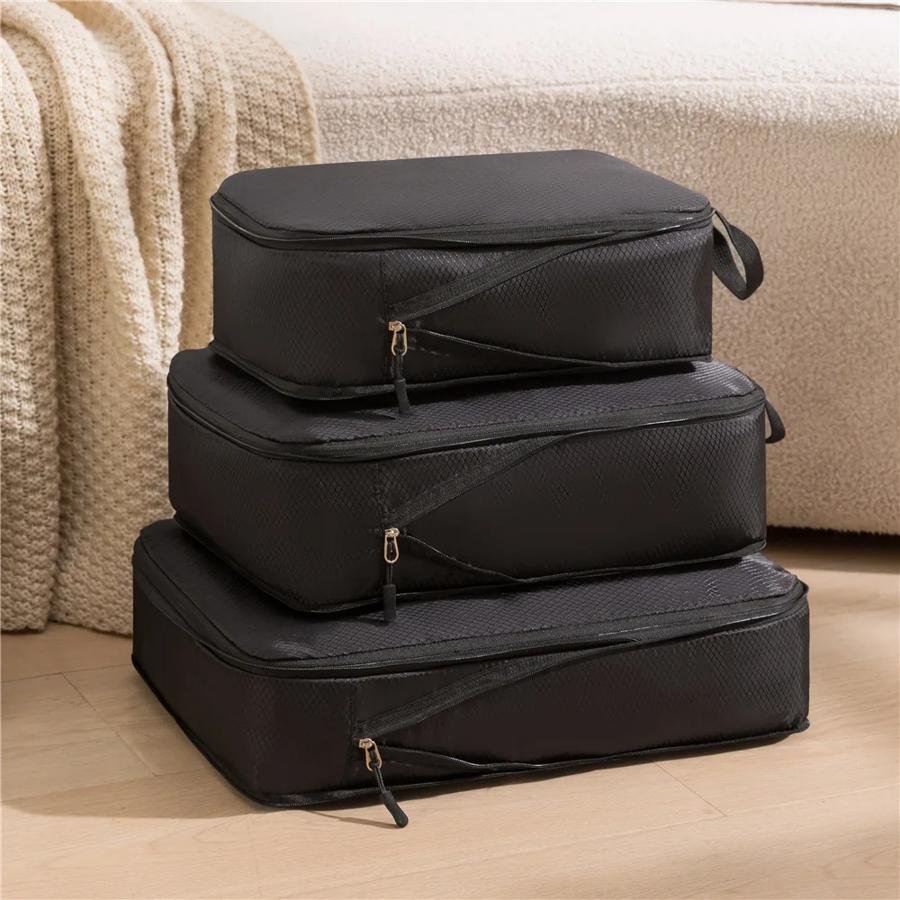
Quick answer: Compression packing cubes do save real space, roughly 20 to 30 per cent on soft, bulky clothing like jumpers and fleeces, by using a second zip to squeeze out trapped air. They will not save space on thin or already-flat items, and they do not reduce weight. For bulky kit and overpackers, the gain is genuine.
What this guide covers
- What compression cubes actually do – A compression cube is a standard fabric cube with a second, outer zip.
- The honest numbers on space saved – Here is where I earn my keep.
- The part the marketing hides – Two honest caveats.
- Compression versus regular versus vacuum – People ask me which type to buy, so here is the ranking after a lot of testing.
- Buying the right ones – The quality markers are the same as any cube, plus one.
- Frequently asked questions – Do compression packing cubes really save space?
I have run compression cubes through the wash, weighed the same clothes packed loose and packed flat, and returned a fair amount of tat that promised the earth. So when I ask whether compression packing cubes really save space, I am not asking rhetorically. I have measured it. The honest answer is yes, but with an asterisk the marketing never mentions, and getting that asterisk right is the difference between a smart buy and a gimmick in a drawer.
Let me give you the tested version, not the box copy.
What compression cubes actually do
A compression cube is a standard fabric cube with a second, outer zip. You fill it, close the first zip, then run the second one to collapse the cube and force out the air trapped between garments. That trapped air is the whole point. Clothing is mostly space, and a chunky jumper is maybe seventy per cent air by volume. Squeeze it out and the same jumper takes a third less room.
That is the mechanism, and it is real physics, not a trick. A compression cube buys you room by deflating your clothes, the way a vacuum bag does but without the hoover.
The honest numbers on space saved
Here is where I earn my keep. Compression works brilliantly on some things and does nothing for others, and knowing which is which stops you wasting money.
| Item type | Space saved | Worth compressing |
|---|---|---|
| Jumpers, fleeces, puffer jackets | 25-30% | Yes, big win |
| Casual cottons, t-shirts | 10-15% | Modest, still useful |
| Jeans and trousers | 10-15% | Some, packs neater |
| Shirts and formalwear | Near zero | No, creases them |
| Underwear and socks | Near zero | No, already dense |
Read that table twice, because it is the whole argument. If you pack fleeces and jumpers for a ski trip or a British autumn, compression is a genuine 25 to 30 per cent gain. If you pack thin summer cottons, the saving is modest and a standard cube is fine. Match the tool to the clothes.
The part the marketing hides
Two honest caveats. First, compression saves volume, not weight. Your bag gets smaller, not lighter, so it helps you dodge a size limit but never a weight limit. Anyone selling compression as a way to beat a 10kg cabin rule is selling you a misunderstanding.
Second, a compressed cube expands the moment you open it. That is fine at the hotel, but it means you cannot compress on the outbound leg and expect the same bag to swallow your souvenirs on the way home unless you leave headroom. I plan for that. Most people forget it and end up sitting on their case in departures.
Compression versus regular versus vacuum
People ask me which type to buy, so here is the ranking after a lot of testing. Standard cubes tidy and organise but do not shrink anything, and for light packers that is all you need, which is why my best packing cubes guide still leads with a standard set for most people. Compression cubes add the space saving with a robust, reusable design and no fragility, and they are my default for bulky trips. Vacuum bags squeeze hardest of all but need a pump or a hoover, puncture, and turn your clothes into a solid brick that creases badly. For travel, compression cubes are the sensible middle, and I would take them over vacuum bags nine times in ten.
Buying the right ones
The quality markers are the same as any cube, plus one. Check the main zip glides, the seams are bound, and the fabric is a firm ripstop. Then check the compression zip specifically, because it takes the most strain and is where cheap sets fail first. A weak second zip on day three leaves you with an ordinary cube and a bad mood. A graduated compression cube set in three sizes covers most trips, and the slate three-size set is the honest, well-built pick I keep recommending. If you want a range of sizes for different loads, the large, small and extra-large options let you match the cube to the clothes.
Before you buy, it is worth reading independent testing on luggage from Which? and knowing your hand luggage rules, because the best compression in the world is wasted if the bag itself is the wrong size.
So, do compression packing cubes really save space? Yes, meaningfully, on the bulky stuff, if you buy a set with a decent second zip and remember it shrinks volume and not weight. For a ski week or a chronic overpacker, they are the best twenty-odd pounds you will spend on travel. For a summer minimalist, a standard set does the job. Match the tool to the trip, and once you have them, my how to use packing cubes guide shows how to load them so the compression actually counts. For strict cabin allowances, the carry-on packing guide is your next read.
Frequently asked questions
Do compression packing cubes really save space?
Yes, on bulky soft clothing. They use a second zip to force out trapped air, saving roughly 25 to 30 per cent on jumpers, fleeces and puffer jackets. On thin cottons the saving is modest, and on shirts, underwear or socks it is near zero, so they suit bulky trips best.
Do compression cubes make your luggage lighter?
No. Compression reduces volume, not weight. Your bag becomes smaller and easier to close, which helps you meet a size limit, but the clothes weigh exactly the same. To meet a weight limit you have to pack fewer or lighter items, not compress harder.
Are compression cubes better than vacuum bags for travel?
For most travellers, yes. Compression cubes are reusable, robust and need no pump, whereas vacuum bags squeeze harder but puncture, crease clothes badly and require a hoover to re-seal. Compression cubes are the practical middle ground for repeated trips.
About the author Neil Hartwell - Tested it, weighed it, ranked it Neil worked in outdoor-kit retail in the Lake District for a decade and now reviews travel gear obsessively. He has stress-tested zips, run compression cubes through the wash and knows which fabrics pill after a year. If a product claims 30% more space, Neil has already checked whether that is true. Writing for The Packing Cube Co..