
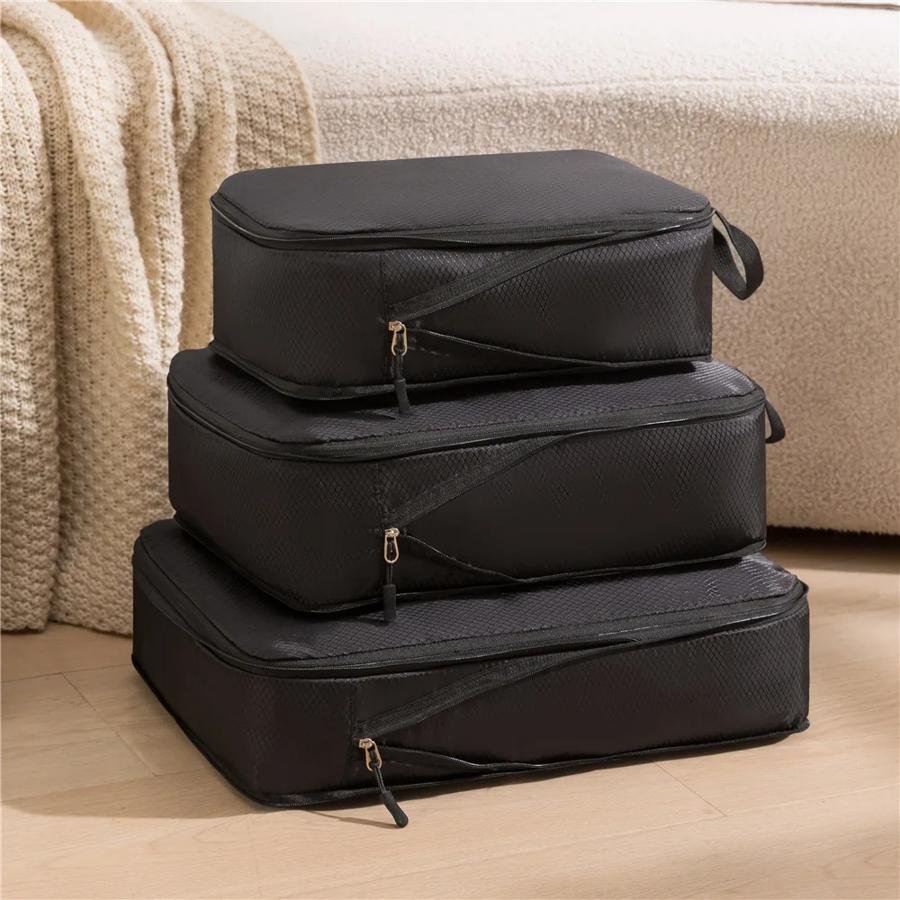
Quick answer: To use packing cubes, give each cube one job, roll soft clothes and fold structured ones, then pack each cube to about ninety per cent full so it stays square. Load the cubes into your case like bricks, heaviest near the wheels, and your suitcase becomes a portable chest of drawers you never rummage through again.
What this guide covers
- Roll, fold, or a bit of both – The rolling-versus-folding debate gets people surprisingly heated, so let me be plain about it.
- One cube, one job – The system only works if each cube has a single, obvious purpose.
- The loading order that saves your back – Pack cubes into the case like bricks, not like a shopping bag.
- Getting more in without the wrestling match – If you consistently run out of room, this is the moment to consider compression rather than more cubes.
- Unpacking is the underrated bit – The joy of cubes shows up at the other end.
- Frequently asked questions – Should I roll or fold clothes in packing cubes?
The first time I saw packing cubes done properly, I was clearing an overhead locker somewhere over the Irish Sea. A passenger had left a case open on her lap, and inside was the tidiest suitcase I had seen in eight years of crew work: four neat fabric boxes, each one a different job, everything visible at a glance. No rummaging, no avalanche of socks. I asked her about it before we landed. Learning how to use packing cubes, she told me, had ended the nightly bedroom war she used to have with her luggage.
That is the whole promise. A packing cube is simply a zipped fabric box that holds one category of clothing so your case becomes a small chest of drawers you can carry. Get the method right and any decent cube earns its keep. Here is exactly how I do it.
Roll, fold, or a bit of both
The rolling-versus-folding debate gets people surprisingly heated, so let me be plain about it. Roll soft, casual things: t-shirts, jerseys, pyjamas, jeans that already look lived-in. Rolling squeezes air out and resists the deep crease. Fold structured things: shirts, linen trousers, anything with a collar or a crease you want to keep. Folded flat inside a firm cube, they arrive presentable.
Most trips are a mix, so most cubes are a mix. Roll the bulk, lay the smart items flat on top, close the lid. The cube holds the shape you gave it, which is the point everyone misses about cubes: they are not just tidiers, they are gentle presses.
Here is my quick rule for what goes where.
| Garment type | Roll or fold | Which cube | Why |
|---|---|---|---|
| T-shirts, casual tops | Roll | Tops cube | Squeezes air out, resists the crease |
| Shirts, linen, smart trousers | Fold flat | Smart cube | Keeps the crease and the collar |
| Underwear, socks, nightwear | Roll or bundle | Small cube | Fills gaps, quick to grab |
| Jeans, jumpers, bulky kit | Roll or compress | Large cube | Reclaims the most room |
One cube, one job
The system only works if each cube has a single, obvious purpose. My standard four:
- Cube one: tops and t-shirts, rolled.
- Cube two: bottoms, trousers and shorts, rolled with the smart pair folded on top.
- Cube three: underwear, socks and nightwear, the small stuff.
- Cube four: the odds. Swimwear, a spare jumper, a scarf.
When each cube means one thing, you never unpack the whole case to find a clean shirt. You pull the tops cube, take one, zip it shut. A packing cube set gives you graduated sizes that map neatly onto these jobs, and the grey six-piece set is a tidy starting point for the four-cube system with two spares for shoes and laundry.
The loading order that saves your back
Pack cubes into the case like bricks, not like a shopping bag. Heaviest and densest at the bottom, near the wheels, so the weight sits low and the case pulls straight. Lighter cubes on top. Fill the gaps around the edges with soft items, a rolled cardigan or a pair of socks, so nothing shifts in transit.
Here is the small trick that makes the difference: pack each cube slightly firm, not stuffed. An overfilled cube bulges and wastes the flat-stacking advantage. A cube packed to about ninety per cent stays square and slots against its neighbours like tiles. If you are working with hand luggage only, that squareness is what lets you use every cubic inch of a strict cabin allowance, and my carry-on packing guide walks through fitting a full week into an underseat bag.
Getting more in without the wrestling match
If you consistently run out of room, this is the moment to consider compression rather than more cubes. A compression cube adds a second zip that flattens the load and reclaims the air. I was a folding purist for years and still am for shirts, but for a puffer jacket or a week of jumpers, compression wins the argument. The honest trade-off and the real numbers are in my compression cubes guide.
Before you buy anything, though, learn the loading first. Nine times out of ten the problem is not too few cubes, it is clothes going in loose. If you do want to upgrade, Which? has sensible testing on luggage, and my best packing cubes guide covers what actually lasts.
Unpacking is the underrated bit
The joy of cubes shows up at the other end. You do not unpack a suitcase, you lift four boxes onto the shelf and you are done in ninety seconds. On a multi-stop trip you never fully unpack at all. Each cube goes on the hotel shelf, comes back to the case at checkout, and the system survives the whole journey intact.
That is the quiet luxury of it. Order, to me, is a form of holiday relaxation, and a well-loaded cube is the closest most of us get to arriving calm. Ready to browse? The full packing cubes range is a good place to see the sizes side by side.
Frequently asked questions
Should I roll or fold clothes in packing cubes?
Both, depending on the garment. Roll soft, casual items like t-shirts and jeans to save space and resist creasing. Fold structured items like shirts and smart trousers flat so they keep their shape. Most cubes end up a sensible mix of the two.
How do I use packing cubes without wasting space?
Give each cube one job, pack it to about ninety per cent so it stays square, and load the cubes into your case like bricks, heaviest at the bottom near the wheels. Fill gaps with soft rolled items so nothing shifts.
Do packing cubes actually make packing faster?
Yes, mostly at the unpacking end. Instead of emptying a whole suitcase to find one shirt, you pull the relevant cube. On multi-stop trips you can leave clothes in their cubes the entire journey and never fully unpack.
About the author Fiona Callaghan - The folding method that changed everything Fiona flew short-haul out of Glasgow for eight years and packed a crew bag for a living before swapping the skies for a slower life. She has seen every packing sin in the overhead lockers and has firm views on rolling versus folding. Order, to Fiona, is a form of holiday relaxation. Writing for The Packing Cube Co..