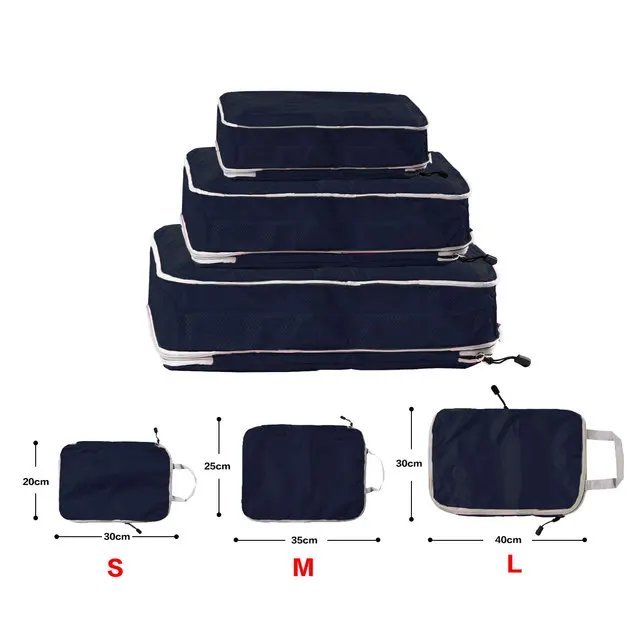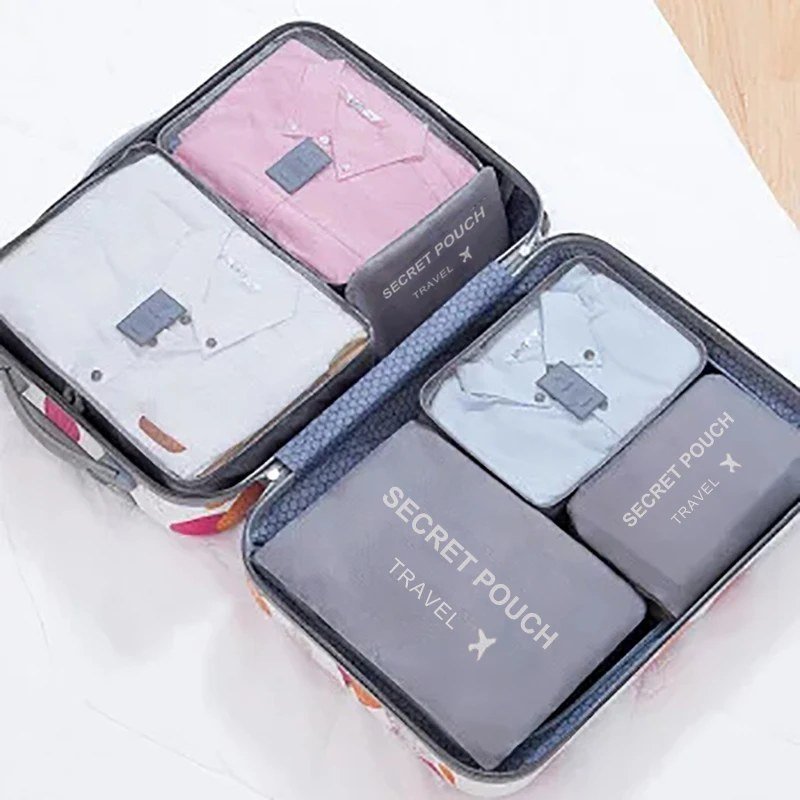
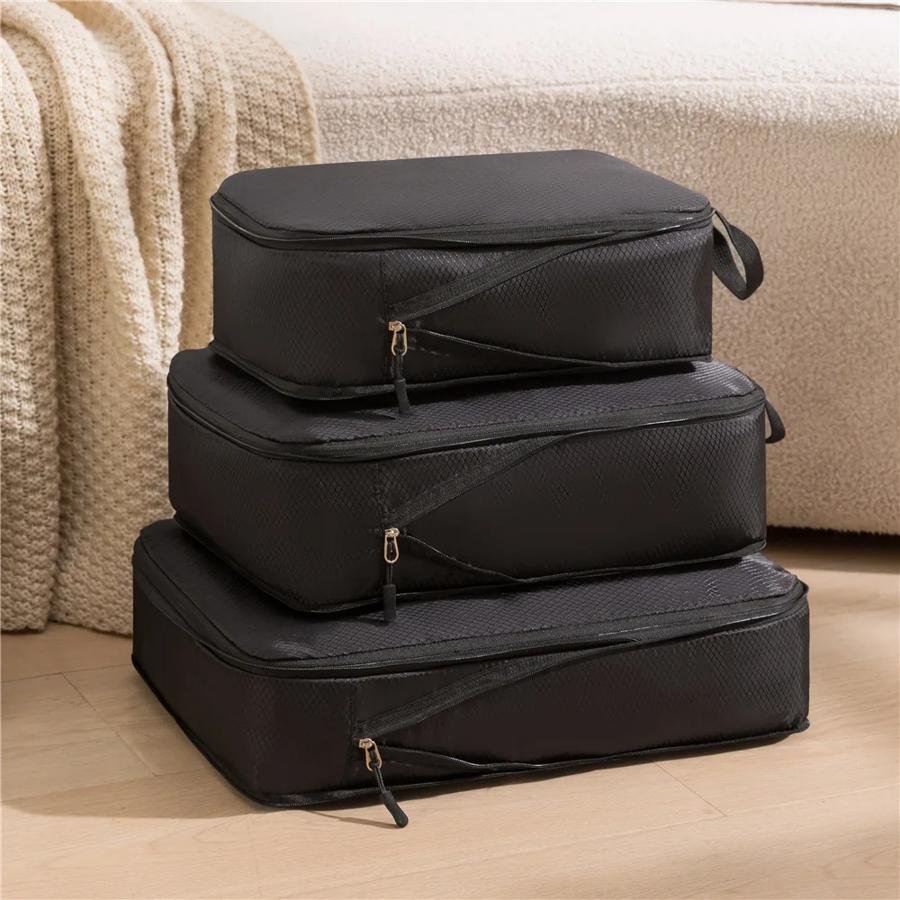
Quick answer: The best packing cubes for backpacking are tall and narrow rather than wide and flat, made in ripstop nylon with a chunky coil zip, and compressible so bulk can be squeezed out. A rucksack loads vertically, so cubes shaped like books stack far better than ones shaped like trays.
What this guide covers
Backpacking is the hardest test a packing cube gets. It is not the mileage, it is the repetition: packed and unpacked most days, crushed into a top-loader, rained on, and washed in a sink.
Most cubes sold for suitcases fail that quietly. They do not rip - the zip just gets gritty and stops running true.
Shape matters more than size
A suitcase is a shallow tray and a rucksack is a deep bucket, so they want different cubes. Wide flat cubes are perfect in a case and useless in a 40-litre pack, where they sit across the opening and block everything underneath.
What works is tall and narrow - cubes that stand like books on a shelf, so you can pull one out from the top without lifting the other three. Our backpack and rucksack cubes are shaped for exactly that, and the same logic runs through how to pack a backpack with cubes.
What to look at before you buy
Three things, in this order:
- The zip. A chunky self-lubricating coil zip, not a moulded plastic one. This is the part that fails, and it fails from grit rather than force.
- The seams. Bound seams last; overlocked ones fray where the cube rubs the inside of a pack.
- The fabric. Ripstop nylon at around 70D is the sweet spot - lighter is flimsy, heavier is dead weight you carry for months.
Mesh tops are worth having for airflow, but full-mesh panels tear on a pack frame. Half mesh, half fabric is the compromise that survives. There is more on judging build quality in our tested guide.
Compression is not optional here
On a suitcase trip compression is a nice-to-have. On a rucksack it is the difference between a 40-litre pack working and not, because you are carrying the volume on your spine rather than wheeling it.
A fleece and a rain shell are mostly trapped air, and squeezing that out recovers roughly a quarter to a third of their packed height. Over a six-month trip that is the space your laundry and your souvenirs live in. Compression cubes earn their weight; the honest numbers are here.
How many, and what goes where
Three or four, no more. One for tops, one for bottoms and layers, one small for underwear and socks, and one that starts empty and becomes the laundry cube. Adding a fifth just means carrying a fifth.
Keep the laundry cube at the bottom of the pack and the day cube at the top. If you are moving on constantly, see the Southeast Asia list for a worked example, and how many cubes you actually need for why more is usually worse.
The short version
- Tall, narrow cubes stack like books in a top-loading rucksack; wide flat cubes block everything beneath them.
- Judge a cube on its zip first – a chunky coil zip is what survives grit, and grit is what kills cubes.
- Ripstop nylon around 70D is the sweet spot: lighter tears, heavier is weight you carry for months.
- Compression matters far more on a rucksack than a suitcase, because you carry the volume rather than wheel it.
- Three or four cubes is the right number, and one of them should start empty as the laundry cube.
Frequently asked questions
What size packing cubes are best for a 40-litre backpack?
Tall, narrow ones rather than wide flat ones. In a 40-litre top-loader you want cubes that stand upright like books so you can lift one out without unpacking the rest. Two mediums, one small and one compression cube is a sensible starting kit.
Do packing cubes add too much weight for backpacking?
A set of three or four adds roughly 200 to 300 grams. That is real, but it is less than one spare pair of jeans, and compression cubes usually buy back more space than their weight costs. If you are counting grams, take fewer cubes rather than lighter ones.
Are mesh packing cubes good for backpacking?
Half mesh is good, full mesh is not. Airflow helps damp clothes and lets you see what is inside, but a full mesh panel snags and tears against a pack frame or a hostel bunk. A fabric base with a mesh top lasts far longer.
How do you wash packing cubes on the road?
By hand, in cold water, with whatever soap you have, then air dry them inside out. Do not put them in a tumble dryer - heat is what warps the zip tape and stops a coil zip running true afterwards.
Should I use compression cubes or a compression sack?
Cubes, if you want to find things. A compression sack squashes better but turns your clothes into one undifferentiated lump, which defeats the point of packing in categories. Compression cubes give you most of the space saving and keep the organisation.