
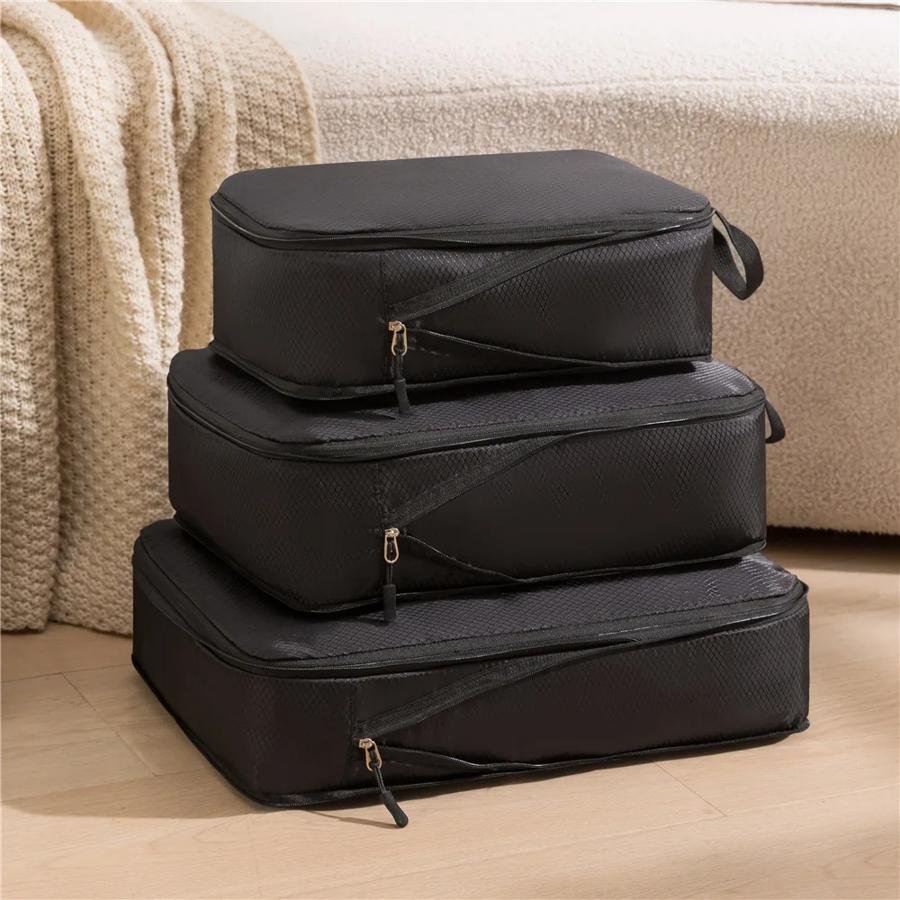
Quick answer: To pack a backpack with packing cubes, load by weight and position, not just category. Put the heaviest cube against the back panel at mid-height so the load sits close to your spine, lighter cubes at the top and bottom, and small dense items low. This keeps the pack balanced and comfortable to carry for hours.
What this article covers
- Backpacks care about weight placement, not just tidiness – In a suitcase you stack cubes like bricks and gravity does the rest.
- The loading order that saves your shoulders – Work from the bottom up, thinking about weight the whole time.
- Compression is a backpacker's best friend – Space is tighter in a pack than a case, so compression matters more.
- Keep it balanced side to side – One more thing a suitcase never taught you: left-right balance.
- Frequently asked questions – How do you pack a backpack with packing cubes?
A suitcase forgives lazy packing. A backpack does not, because you wear your mistakes on your shoulders for the next six hours. I have carried a single 40-litre bag across five continents, and the difference between a pack that floats and a pack that wrecks your back is entirely down to how you load it. Knowing how to pack a backpack with packing cubes is really two skills: sorting your kit, and placing the weight. Get the second one right and the bag disappears on your back.
Here is the method, spine outward.
Backpacks care about weight placement, not just tidiness
In a suitcase you stack cubes like bricks and gravity does the rest. In a backpack, physics is against you. A pack loaded badly pulls you backwards and hangs off your shoulders; a pack loaded well sits close to your centre of gravity and rides on your hips. The single rule that matters: heavy weight goes against the back panel, close to your spine, at roughly mid-height between your shoulder blades and your waist.
So you do not just sort cubes, you place them. Backpack-shaped backpack and rucksack cubes are cut to slot into the tapering shape of a pack, which a boxy suitcase cube fights.
The loading order that saves your shoulders
Work from the bottom up, thinking about weight the whole time.
- Bottom of the pack: light, bulky, low-need items. Your sleeping layer, a fleece, tomorrow's clothes. A soft base you will not need until camp.
- Middle, against the back panel: the heaviest cube, tight to your spine. This is your load anchor.
- Middle, away from the back: lighter clothing cubes filling the outer space.
- Top: things you need fast. A rain layer, snacks, a small day cube.
- Hip-belt and lid pockets: passport, phone, the essentials you reach for hourly.
A graduated packing cube set lets you match cube size to each zone, and for a backpacker the small dense cube of socks and underwear is the ideal thing to wedge low and central.
Compression is a backpacker's best friend
Space is tighter in a pack than a case, so compression matters more. A compression cube flattens your bulky clothing and buys back real room, which on a long trip is the difference between fitting your kit and leaving something behind. The navy small, medium and large set covers the range, and I go through the real space maths in my compression cubes guide. One honest warning: compress the outbound load and leave headroom, because a compressed pack has no give for the things you pick up on the road.
Keep it balanced side to side
One more thing a suitcase never taught you: left-right balance. A pack heavier on one side twists your spine and ruins a day's walking. As you load, split dense items evenly across the width so the pack sits square on your back. Cubes help here, because two matched cubes side by side balance more predictably than a loose jumble that all slides to one side on the first hill.
If you are flying with the pack as cabin luggage, check it against the hand luggage rules, and the UK Civil Aviation Authority is the neutral source for what airlines can and cannot enforce. My carry-on packing guide shows how to fit a week into a pack that still meets a strict allowance.
Pack a backpack this way, heavy to the spine at mid-height, balanced side to side, compressed where it counts, and the bag stops being a burden and becomes part of you. Sort your kit into cubes, place the weight deliberately, and you can walk all day. For the full sorting and rolling method, my how to use packing cubes guide is the next read, or browse the backpack cube range to get started.
Frequently asked questions
How do you pack a backpack with packing cubes?
Sort kit into cubes, then place them by weight. Put the heaviest cube against the back panel at mid-height, close to your spine, with lighter cubes at the top and bottom and small dense items low. Balance dense items evenly side to side so the pack sits square and rides comfortably.
Where should the heaviest items go in a backpack?
Against the back panel, close to your spine, at roughly mid-height between your shoulder blades and waist. This keeps the load near your centre of gravity so the pack rides on your hips rather than pulling on your shoulders or tipping you backwards on the trail.
Are compression cubes good for backpacks?
Yes. Space is tighter in a pack than a suitcase, so compression cubes that flatten bulky clothing genuinely help you fit everything in. Compress the outbound load but leave some headroom for things you pick up on the trip, since a fully compressed pack has no give.
About the author Tom Ackerley - One bag, forty countries, no checked luggage Tom spent six years as a courier flying documents across Europe before going freelance and never looked back at a baggage carousel. He has boarded flights on five continents with a single 40-litre bag and runs the numbers on every gram. He genuinely gets a thrill from walking straight past luggage reclaim. Writing for The Packing Cube Co..