Quick answer: Liquids in hand luggage must be in containers of 100ml or less, all fitting inside one transparent resealable bag of up to one litre, about 20cm x 20cm. It is the container size that counts, not how full it is, and pastes, gels, creams and sprays all count as liquids.
What this guide covers
Nobody enjoys the liquids bag. It is the one bit of airport security that turns a calm morning into a scramble at the tray, usually because a full-size shampoo has been found at the bottom of a wash bag.
The rule itself is simple. The trouble is that people pack the toiletries first and think about the rule second, which is exactly the wrong way round.
Here is the rule, then a packing method that means you never have to think about it again.
The 100ml rule, plainly
At UK airports, liquids in hand luggage must be in containers of 100ml or less. Every container has to fit inside one transparent, resealable bag holding no more than a litre — roughly 20cm x 20cm. One bag per passenger, and it usually comes out of your bag and into the tray on its own.
Two things trip people up. The first is that the limit is the size of the container, not how much is left in it: a half-empty 200ml bottle is still refused. The second is that a great many things count as a liquid when you would not think of them that way.
Some UK airports have installed next-generation scanners, and the allowances at those have changed more than once in recent years. Because it can differ airport to airport, and can change at short notice, pack to the 100ml rule by default and check the government's hand luggage restrictions page and your departure airport before you fly. Packing to the strictest version costs you nothing if the rules turn out to be looser.
What counts as a liquid
More than you would guess. If it can be squeezed, poured, sprayed or spread, treat it as a liquid:
- Toothpaste, and any other paste
- Deodorant — roll-on, gel and spray (a solid stick is fine)
- Sun cream, moisturiser and any other cream
- Mascara, liquid foundation, lip gloss and nail varnish
- Hair gel, wax, mousse and dry shampoo
- Contact lens solution
- Perfume and aftershave
- Jam, honey, soft cheese and anything else spreadable
The exemptions worth knowing: baby milk and baby food, and essential prescription medicines, may go over 100ml. Expect to declare them and have them screened separately, and carry a prescription or a letter for medicines. Duty-free bought airside is fine in its sealed bag — keep the receipt inside it.
The method: decide the bag first
The mistake is packing toiletries into a wash bag and then hunting for the liquids that need to come out. Do it the other way round.
Keep a clear liquids bag permanently packed with the 100ml versions of what you actually use. Not what you might use — what you use. For most people that is six or seven items, and it never needs unpacking between trips.
Then everything not a liquid — brush, solid deodorant, razor, hairbands, plasters, contact lens case — lives in a normal wash bag. At security, the clear bag lifts straight out and the rest stays put.
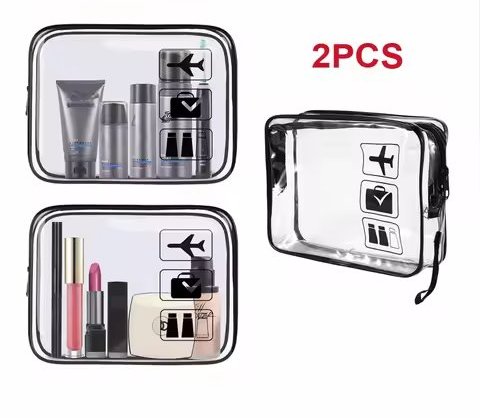
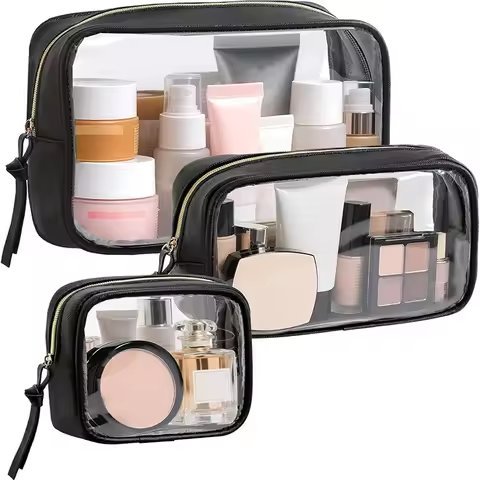
That is the whole trick: two bags, one of which never changes. A clear toiletry bag that already meets the size rule does the thinking for you, because you physically cannot overfill it.
Clear bag or freezer bag?
| Supermarket freezer bag | Proper clear travel bag | |
|---|---|---|
| Cost | Pennies | A few pounds, once |
| Lasts | A trip or two | Years |
| Seal | Press-together, splits | Zip, holds |
| If something leaks | Leaks into the case | Contained, wipes out |
| Size | Guesswork | Made to the limit |
| At the tray | Fiddly to reseal | One movement |
A freezer bag genuinely works. It is just the thing most likely to split in a bag of clothes, and a leaked bottle of factor 30 is a memorable way to start a holiday.
Where the bag goes in your case
Put the liquids bag in an outer pocket or the very top of your cabin bag. Not under the clothes. The entire point is that you can reach it without unpacking, and the person behind you in the queue will quietly thank you.
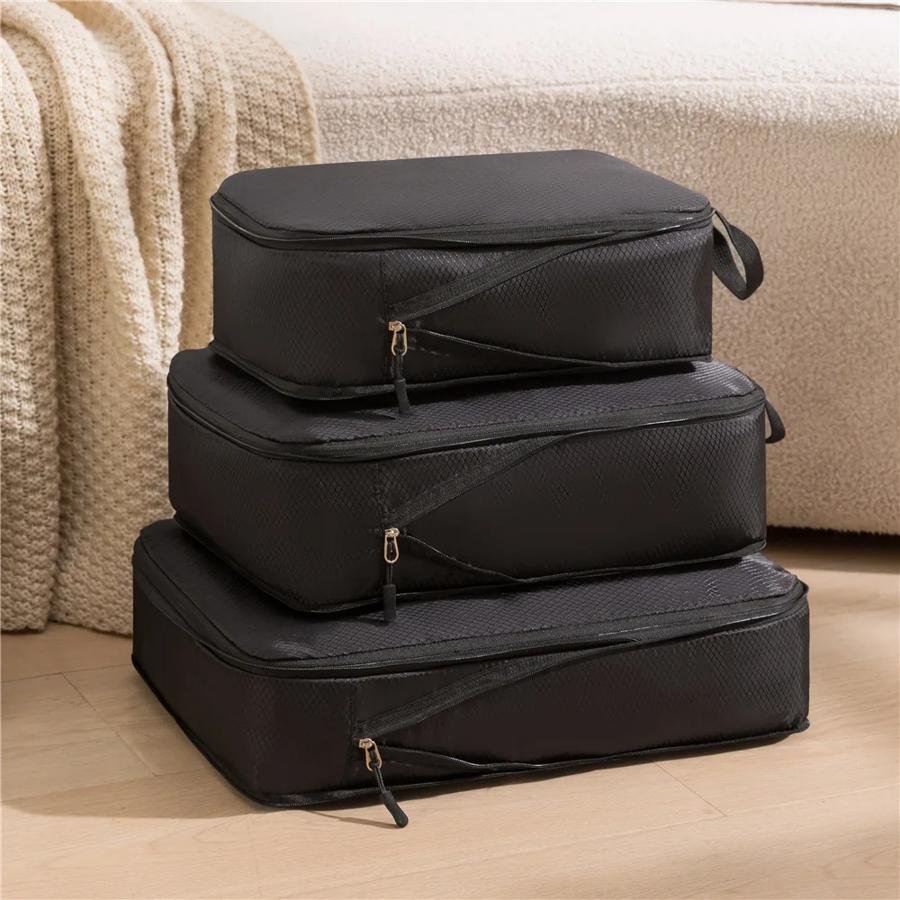
If you pack with packing cubes, the liquids bag sits on top of the cubes rather than inside one. Cubes hold their shape, so there is usually a flat gap at the top of the bag that fits it exactly. Our carry-on packing guide covers the loading order in full.
On a strict under-seat allowance like Ryanair's 40x20x25 bag, the liquids bag is one of very few things worth giving prime space to, because it is the only item you are guaranteed to need to reach.
Cutting what you carry
Most people pack toiletries for a version of themselves who has more time than they will have.
- Decant, don't buy travel sizes. Refillable 100ml bottles cost less over time and hold the products you actually like.
- Go solid where you can. Solid shampoo, conditioner bars and stick deodorant are not liquids, so they leave the bag entirely.
- Share with whoever you are travelling with. Two people rarely need two tubes of toothpaste for a long weekend.
- Buy the bulky things there. Sun cream is available in every sunny country, usually more cheaply than at the airport.
Do those four and the litre bag stops being tight. For a longer trip, the overflow goes in the hold with everything else — the 100ml limit applies to hand luggage only, and full-size bottles in checked luggage are fine.
If you are travelling hand luggage only
Then the liquids bag is a hard ceiling, and it is worth being honest about it. A week of hand luggage only travel works fine on 100ml bottles. Three weeks does not, unless you plan to buy things when you land, which is usually the right answer.
Compressing the clothes buys you the space to carry a slightly fuller wash bag — that is what compression cubes are for. The liquids allowance itself, though, does not move.
A packing order that works
- Fill the clear bag first, from a list you keep
- Anything that will not fit, decant or leave out
- Non-liquids into the wash bag
- Clothes into cubes, cubes into the case
- Wash bag alongside the cubes, clear bag on top or in an outer pocket
Five steps, and the only one that needs any thought is the second. Do it the night before rather than the morning of, and airport security becomes the least eventful part of the day.
If anything here is still unclear, the FAQ page covers the questions we get asked most, and the complete guide to using packing cubes covers the rest of the case.
The short version
- Liquids in hand luggage must be in containers of 100ml or less, all inside one transparent resealable bag of up to 1 litre – about 20cm x 20cm.
- It is the container size that counts, not how full it is: a half-used 200ml bottle is still refused.
- Pastes, gels, creams and sprays all count – toothpaste, sun cream, mascara and roll-on deodorant included.
- Keep a clear bag permanently packed with the 100ml things you genuinely use, and never unpack it between trips.
- Baby milk, baby food and essential medicines may exceed 100ml, but expect to declare them and have them screened separately.
Frequently asked questions
What is the 100ml liquids rule?
Liquids in hand luggage must be in containers holding 100ml or less, and every container has to fit inside a single transparent, resealable bag of no more than one litre, roughly 20cm x 20cm. One bag per passenger, and it normally goes in the tray on its own at security.
Does a half-empty 200ml bottle count as under 100ml?
No. Security judges the size printed on the container, not how much is left in it. A 200ml bottle with 50ml in it will still be taken off you, which is why decanting into 100ml bottles is the only reliable answer.
Is toothpaste a liquid for airport security?
Yes. Toothpaste is treated as a liquid, along with other pastes, gels, creams and sprays – so sun cream, moisturiser, mascara, hair gel, roll-on and spray deodorant and contact lens solution all go in the bag. A solid deodorant stick or a shampoo bar does not.
Can I take medicines and baby milk over 100ml?
Yes. Essential prescription medicines, baby milk and baby food are exempt from the 100ml limit. Carry a prescription or a doctor's letter for medicines, keep them accessible, and tell the officer before you go through – they will usually be screened separately.
Do I still need a clear bag if my airport has the new scanners?
Assume you do. Allowances at UK airports with next-generation scanners have changed more than once, and they can differ from one airport to the next. Packing to the 100ml rule costs you nothing if the rules turn out to be looser, so check your departure airport before you fly and pack for the strictest version.