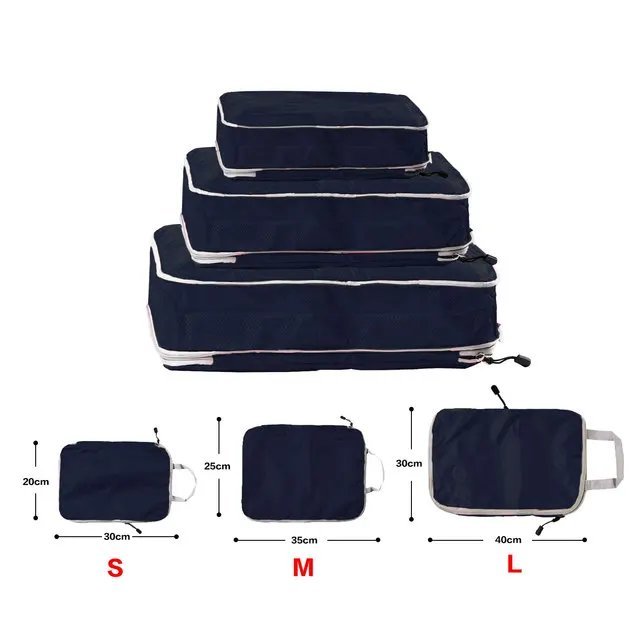
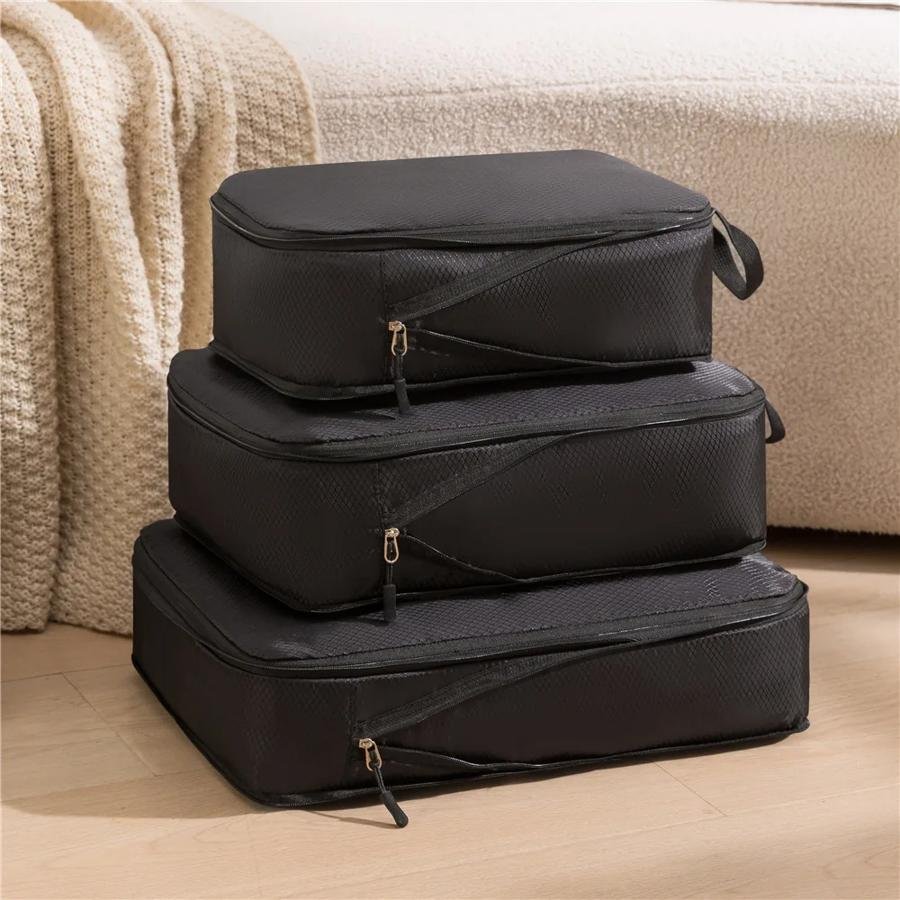
Quick answer: The best packing cubes for a cabin bag are small and medium compression cubes, not the large ones sold for suitcases. A cabin bag is volume-limited, so the cube that helps is the one that removes trapped air and lets a soft bag flex into the sizer.
What this guide covers
Most packing cube sets are designed around a hold suitcase. Put those same cubes in a cabin bag and two of them will not fit, which is how people conclude cubes do not work for hand luggage.
Size down, deliberately
A standard cabin bag is roughly 55 x 40 x 20cm and the depth is the constraint. A large cube designed for a hold case is often deeper than the bag itself.
What works is two mediums and a small, or three smalls if you are on an underseat-only fare. Our size guide lists actual dimensions rather than descriptions, which is what you need when the bag is the limit.
Compression, not just organisation
In a hold case, a standard cube is enough – you have the volume, you just want to find things. In a cabin bag you are fighting for centimetres, and standard cubes do not create space.
Compression cubes do, by removing the air out of whatever is bulky. On a week's packing that is often the difference between the bag closing and not – the measured figures are in how much space they save.
Soft bag, square load
Two things decide whether a bag drops into a sizer. The first is that the bag itself should be soft-sided, because a soft bag gives up its last centimetre and a hard shell does not.
The second is that the load inside should be square. Loose clothing bulges at the corners, which is exactly where a frame catches. Cubes give a soft bag the shape it was designed to have – the method is in the carry-on guide.
A workable cabin kit
- One medium compression cube – tops and any warm layer
- One small cube – underwear, socks, nightwear
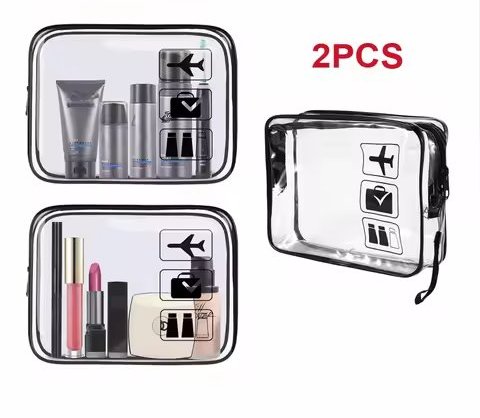
- A clear liquids bag, permanently packed
- A flat wash bag for the non-liquids
That covers four to five days comfortably. Beyond a week you are into laundry rather than luggage – see the easyJet post for a worked example against a real allowance.
The short version
- Cabin bags are depth-limited – a large cube built for a hold case often will not fit at all.
- Two mediums and a small is the standard kit; three smalls for an underseat-only fare.
- Standard cubes organise but create no space; in a cabin bag you need compression.
- A soft-sided bag squashes into a sizer where a hard shell either fits or does not.
- Cubes square off the load, and bulging corners are exactly what a sizer catches.
Frequently asked questions
What size packing cubes fit a cabin bag?
Small and medium. A standard cabin bag is around 20cm deep, and large cubes designed for hold suitcases are often deeper than that. Two mediums and a small is the usual workable combination.
Do packing cubes help hand luggage fit the sizer?
Compression cubes do, because they remove trapped air and stop clothes bulging at the corners of a soft bag. Standard cubes tidy the bag but do not make it any smaller.
How many days can you pack in a cabin bag with cubes?
Four to five comfortably for most people, and a week if you choose clothes that all combine and wear your bulkiest layer to the airport. Past that, the limiting factor becomes laundry rather than space.
Should I use a hard or soft cabin bag?
Soft, if you are ever near the size limit. A soft bag packed in squared cubes will compress the final centimetre into a sizer frame; a hard shell is simply the size it is.
Are compression cubes allowed in hand luggage?
Yes, there is no restriction on them at all. They are usually the single most useful thing you can put in a cabin bag, since cabin allowances limit volume rather than weight.